Wednesday, January 26, 2011

Big cities are not always biggest polluters

Big cities like New York, London and Shanghai send less pollution into the atmosphere per capita than places like Denver and Rotterdam, said a study released Tuesday.

The sun sets over the Manhattan skyline. Big cities like New York, London and Shanghai send less pollution into the atmosphere per capita than places like Denver and Rotterdam, said a study released Tuesday.

Researchers examined data from 100 cities in 33 nations for clues about which were the biggest and why, according to the report in the peer-reviewed journal Environment and Urbanization.

While cities across the world were to blame for around 71 percent of the world's greenhouse gas emissions, urban dwellers who can use public transport rather than drive helped to lower per capita emissions in some cities.

For instance, the sprawling western US city of Denver's per capita emissions were nearly double those in New York City, home to eight million inhabitants and a gritty, heavily used subway system.

"This is mainly attributable to New York's greater density and much lower reliance on the automobile for commuting," said the study.

Even Denver's per capita emissions, at 21.5 tonnes of carbon dioxide equivalent, were sharply higher than Shanghai at 11.2 tCO2e, Paris (5.2) and Athens (10.4).

Chinese cities stood out from the rest of the world because their average emissions were far higher -- for instance with Beijing emitting 10.1 tonnes of equivalent -- than the country as a whole which emits 3.4 tCO2e.

"This reflects the high reliance on for , a significant industrial base within many cities and a relatively poor and large rural population," said the study.

Looking at greenhouse gas emissions per GDP, researchers found that "citizens of Tokyo are 5.6 times more efficient than Canadians."

The port city of Rotterdam in the Netherlands got a particularly bad rap because of its links to shipping and heavy industry.

"Rotterdam's per capita value of 29.8 tCO2e versus 12.67 tCO2e for the Netherlands reflects the large impact of the city's port in attracting industry, as well as fuelling of ships," said the study.

"This is similar to cities with busy airports and highlights the need to view the city-based GHG emissions cautiously and holistically."

Other trends included the tendency for cities in cold climates to have higher emissions, and for poor and middle income countries to have lower emissions per capita than wealthy countries.

When researchers looked at cities in Asia, Latin America and Africa, they found low emissions per person across the board.

"This paper reminds us that it is the world's wealthiest cities and their wealthiest inhabitants that cause unsustainable levels of , not cities in general," said editor David Satterthwaite, a senior fellow at the International Institute for Environment and Development.

"Most cities in Africa, Asia and Latin America have low emissions per person. The challenge for them is to keep these emissions low even as their wealth grows."

An analysis of three neighborhoods in Toronto found that the highest emissions came from the suburbs, where streets are lined with large single family homes that are far from commercial centers.

The lowest levels of emissions came from areas with apartment complexes in walking distance to shopping and transit.

Tuesday, January 25, 2011

Print From iOS and Android to Any Printer with Google Cloud Print

Google’s Cloud Print is now live, and you can print directly from your Android or iOS device to any printer you might have lying around. Right now, you can see the new feature by going to Gmail and pressing the double-arrowed “more” button. “Print” is now an option in the resulting drop-down menu.

Unlike Apple’s AirPrint, which works over the local Wi-Fi network and currently requires an AirPrint-compatible printer (or an easy workaround), Cloud Print sends your print jobs via the internet. You need to install the Chrome browser onto any computer with a printer, and then enable Cloud Print in the settings. This is tied to your Google account, and there’s even a page for managing your printersand print jobs.

Right now, you’ll need a Windows PC hooked up to the printer, running Google Chrome 9.0.597.1 or later. Linux and Mac support should be following soon. Currently you can print emails from Gmail and documents from Google Docs. You can also print from Google’s Chrome notebook computers.

This is exactly how printing should always have worked – no worrying about drivers or installations, just sign into your account and print. It’s ironic it has happened just when most of us no longer need to print anything onto paper. I have been using a version of this ever since I ditched my own printer years ago: I just email my documents to the local copy shop and pick them up on my way to the bar next door.

Monday, January 24, 2011

Analysis: Android files likely to worsen Google's case

Android Java file study hurts Google's chances

A dispute erupting over the legitimacy of claims that Google more directly copied Oracle code in Android may have been settled on Friday with a study. Following assertions that the files were just for testing and in some cases had already been deleted, Engadget's Nilay Patel argued that the technical issues were irrelevant and the files' very existence could make Google liable. Even if removed from the current code tree, inserted automatically or absent from current phones, the attempts to change the licenses may have violated Oracle's copyrights.

"Somewhere along the line, Google took Oracle's code, replaced the GPL [licensing] language with the incompatible Apache Open Source License, and distributed the code under that license publicly," Patel said. "That's all it takes -- if Google violated the GPL by changing the license, it also infringed Oracle's underlying copyright."

Even outside of the contested code, Oracle has already pointed to more direct examples that it contended were direct copies of the Java technology it owns following the Sun buyout. Google has accused Oracle of misrepresenting code to artificially strengthen its lawsuit, but the discoveries on Friday of raw details could leave it with few defenses.

Oracle in its lawsuit against Google has been pushing for royalties from every Android phone shipped and could significantly hike the prices of each unit sold. The findings could also damage Google's reputation if it's thought to have created its open-source code by using material without permission.

Friday, January 21, 2011

AT&T giving out free MicroCells, may tier LTE by speed

ATT to give MicroCells and segment 4G

Two leaks on Friday have detailed some of AT&T's plans both to accommodate oversaturation on its 3G network and to segment its 4G network. One slip has revealed that AT&T will hand out free 3G MicroCell routers to the 7.5 percent of customers likely to have poor indoor reception. The only limit Engadget noted was a one-year contract specific to the femtocell; breaking the term would cost the newly raised $200 price minus $16.67 per month for every month the user remains with AT&T.

As with phone trade-ins and arange of other sweeping changes, the deployments would start on January 23. Only those who received direct mail would qualify for the upgrade.

The gesture is likely to address criticism from customers in areas with overloaded 3G service, such as New York City and the San Francisco Bay Area. AT&T has had a trial program in place, but those who haven't qualified have had to pay on their own, even when they could demonstrably prove that they had no cellular service at home.

Separately, an internal memo has given away some early if tentative plans for AT&T's LTE-based 4G service. The BGR note hinted that AT&T will still cap the service for at least some subscribers but may also separate it by speeds. At least on lower tiers, customers would have the option of Speed Up Sessions that would temporarily supply a faster connection. Rather than pay per gigabyte for extra bandwidth, they would also have the option of Top Up Sessions to add a fixed amount.

What the speeds and caps would involve isn't known. AT&T is likely to raise the caps for the much faster 4G speeds as users would otherwise run out of their available bandwidth almost immediately. LTE in its current form peaks at 100Mbps downstream in ideal conditions, although Verizon has said its already active service should get 5-12Mbps under a full load at realistic distances.

The company has only officially said it would take LTE live in mid-2011, but the internal data has trials starting with the speed-limited plans in May.


Read more: http://www.electronista.com/articles/11/01/21/att.to.give.microcells.and.segment.4g/#ixzz1BhgCXo9a

I really want to try one of these!

20110121-hot-dog-of-the-week-ecuador-art.jpg

More evidence shows Google may have copied Oracle in Android

Oracle's claims that Google copied Sun's Java code without permission in Android may have gained fuel on Friday. A separate search by Florian Mueller of the code (ZIP) has found more files than Oracle itself cited that appear to lift code directly. Among them, six files attached to Android 2.2 and 3.0 appear to have been extracted from Sun's Java source code using a decompiler and simply grafted into the just-in-time Dalvik engine Android uses at its root.

About 37 files were even marked as "proprietary/confidential" Sun files, and a separate file included in the code served as a copyright notice from Sun urging users not to distribute the material. Google has since claimed that Oracle was hiding code to make it look like more copying was involved, but Mueller noted that even open-sourced, GPL 2 parts code could have violated Sun (and now Oracle) rights after the latter's code was distributed without its consent. He suggested that Oracle not only had a case but may have been conservative in presenting its evidence.

"It seems to me that Oracle has not even presented the tip of the iceberg in its amended complaint," Mueller said. "The discovery process could be very fruitful for Oracle, and may become dreadful for Google."

While Google has accused Oracle of being opportunistic and arguing for proprietary Java code rights only after it bought Sun and could profit from licensing, the discoveries could have significant ramifications for Android. Google has regularly tried to claim the high ground over Apple by touting Android's openness. The findings nonetheless imply that it took code it either knew was closed-source or that was improperly taken when while open.


Read more: http://www.electronista.com/articles/11/01/21/discovery.shows.android.may.have.copied.more.java/#ixzz1BhZ03qWd

HTC surges 160% thanks to Android, to ship 8.5m phones in Q1

HTC has banner 2010, promises 8.5m in Q1 2011

HTC on Friday said its profit jumped 160 percent in the fall as part of record business it expected to accelerate this year. Its decision to focus on Android for almost all of 2010 saw it reach a net profit of $501.2 million. A push on North America was evident as more than half of the $9.55 billion in revenue it made in all of 2010, 50.6 percent, came from North America; it shipped 24.6 million phones worldwide last year.

The company also expected that growth to pick up in 2011 and forecast that it would ship 8.5 million phones in the first quarter of this year. HTC would double production at its main Shanghai factory to two million phones every month to keep up with demand, CEO Peter Chou said. It was counting on phones using HSPA+ or LTE to drive these sales and singled out both the Inspire 4G at AT&T andThunderbolt at Verizon as its halo devices so far.

Although not mentioned, HTC is also likely to launch a wide range of new phones at Mobile World Congress in mid-February and could have a Desire sequel along with as many as four other models. Chou confirmed that his firm was working on a tablet as well, but wouldn't name it; leaks have revealed that it twice as many iPhones in the fall as HTC planned to ship in the winter. Combined with Motorola and other core Android developers, it could still help Android outsell iOS in phones, although not when including media players and tablets.


Spotify reportedly signs US deal with Sony


Just a week ago, we covered a New York Post story indicating that Spotify, the ad-supported or subscription based all-you-can-eat music streaming service, was about to sign a deal with Sony Music in the U.S. -- taking Spotify a step closer to the U.S. market.

Now, according to MediaMemo, that deal has now gone through. Though both Spotify and Sony have declined to comment, it's reported that a deal -- similar in terms to Spotify's European music label deals -- has been reached.

However, Spotify still needs to secure further agreements (or at least one big arrangement) with other music labels, to increase its catalogue, before it can begin offering a service in the U.S.. Spotify is facing some big hurdles, though. According to MediaMemo, the labels are anxious "...that Spotify's free streaming service will increase the decline of CD sales, which have been dropping for a decade, but still make up the majority of the labels' revenue. And, "...there is also muttering that the labels don't want to upset Apple, which sells tunes on a track-by-track basis via its iTunes store and dominates the market for digital music."

However, last week The Post also reported that Spotify had the support of one other unnamed major music label. Though there seems to be an apprehension amongst U.S. music labels towards Spotify, perhaps we'll be hearing reports of another Spotify / major music label deal in the coming days.

iPhone 5 rumours: what you need to know

The latest speculation about the iPhone 5G release

iPhone 5 (or the iPhone 5G, as some are calling it) rumours are flying thick and fast already.

Will there be a rush release to erase memories of the iPhone 4's antenna problems?

Will the 5th generation iPhone deliver ultra-fast mobile internet? Will it ever end up on Verizon in the US?

Let's raid the iPhone 5 rumour fridge to find the tomatoes of truth amid the stinky stilton of baseless speculation.


The iPhone 5 isn't the Verizon iPhone, and vice versa

The Verizon iPhone rumour has been around forever, and one day it'll come true - but it won't be the iPhone 5. The Wall Street Journal said a Verizon iPhone was nearly ready back in October, and we'd take that one seriously: the WSJ is the paper Apple tends to share its secrets with.

It says that "the [Verizon] phone would resemble the iPhone 4 currently sold by AT&T, but would be based on an alternative wireless technology used by Verizon, these people said." Which people? "People familiar with the matter".


The iPhone 5 will have a different form factor to the iPhone 4

WSJ: "Separately, Apple is also developing a new iPhone model, said people briefed on the phone. One person familiar said the fifth-generation iPhone would be a different form factor than those that are currently available… it was unclear how soon that version would be available to Verizon or other carriers."

This has since been backed up by reports from Engadget we reported on 17 January 2011, which state the design will be a 'total rethink'.


The iPhone 5 specs will be evolutionary, not revolutionary

According to the Chinese Economic Daily News (via AppleInsider), with the exception of Qualcomm chipsets - which would replace the current Infineon chipsets in the iPhone 4 - Apple's sticking with the same suppliers for the 2011 iPhone 5G components.

We'd expect the basics of the iPhone 5 specs to get a bump - more memory, faster processor, more storage - but DVICE quotes a single insider who claims to have handled Verizon prototypes.

The specs? A new antenna, 1.2GHz processor and a larger screen: 3.7" instead of 3.5". The iPhone 5 may also be made from a new kind of alloy, or maybe meat.

However, we're also hearing word of a multi-core design, in keeping with the rest of the mobile world, as Apple looks to improve both battery life and performance.

The iPhone 5 will also get a massive graphical boost as it moves to a dual-core GPU - this could herald true 1080p output from the new device, according to our news story on 18 January.


The iPhone 5 specs may include a digital wallet

There's been some speculation that Apple might include Near Field Communication (NFC) technology in the iPhone 5G, turning it into a kind of credit/debit card. However, as Techeye.net notes, "Apple has looked into NFC before" so this might not be imminent.

Near field communication

PAY PHONE: Apple patents show how a near field communication-equipped iPhone 5 could act as a kind of credit card


The iPhone 5 release date will be in the summer…

Apple's established a rhythm with iPhone releases, with new models appearing in late June or early July each year. It's a safe bet that the iPhone 5 release date will also be late June or early July.

As Beatweek magazine points out, Apple's A-Team can't be everywhere at once; by staggering the releases of the iPad 2 and the iPhone 5, they get to work their magic on both devices.


…or maybe the iPhone 5 release date will be earlier

iLounge said its source reckoned Apple would push the iPhone 5 release date forwards - possibly to January 2011 - because of the iPhone 4 antenna problems, although iLounge itself said the claim was "hard to believe". The source could be confusing the Verizon iPhone and the iPhone 5.

The usual July release date was mentioned by Engadget's source too in January 2011 - meaning the standard release cycle looks set to continue.


The iPhone 5 specs may include LTE support

At least one analyst thinks the iPhone 5 will support LTE, super-fast mobile broadband, in the US. That would make the iPhone 5G a 4G phone, which won't be confusing at all. LTE is certainly coming - AT&T plans to roll out its LTE service in 2011 - but an LTE iPhone has been rumoured for a while. USA Today floated the idea of an LTE iPhone on Verizon last year.


The iPhone 5 price won't change

If the iPhone 5 is an evolutionary step like the move from the iPhone 3G to the iPhone 3GS then we'd expect the price to stay more or less the same, although in the UK higher VAT rates may well mean a higher price tag.


iPhone 5 set to be 'completely redesigned'

Possibly running new dual-core chipset too


Clues about Apple's forthcoming iPhone 5 have been leaked online, claiming that the new device will have a new powerful CPU and feature another redesign.


Engadget is quoting 'extremely accurate' sources in saying that not only will the new device land in the summer (in line with every iPhone launch for the past few years) but Apple will be looking to keep the iPhone 5 at the sharp end of mobile technology.


To that end, we can expect to see Apple's new A5 CPU, an ARM Cortex A9 chipset, which will be multi-core, enabling much better battery life and even more power from the fruity phone.


Total rethink


And despite redesigning the chassis of the iPhone for the first time in its life with the iPhone 4, Apple is set to have 'a total rethink from a design standpoint' for the new iPhone 5.

The other big rumour is Apple is apparently thinking of moving away from using Infineon chipsets for the GSM radio (the part of the phone that connects to your mobile network) and shifting to Qualcomm – feasibly due to the connectivity problems which plagued the last iPhone launch.


It's not a lot to get excited about at the moment, but if true, it will likely once again leave those that snapped up an iPhone 4 on a two year deal cursing their decision in June.


Tuesday, January 18, 2011

iOS users beating Android counterparts in update battle

Posted on Jan 18, 2011 3:25 pm by Daniel Ionescu, PC World

Almost 90 percent of iOS device owners are running the latest major revision of the OS, according to figures released by a prominent iOS app developer. In a stark contrast, Google’s latest Android version (2.3) is installed on only 0.4 percent of devices, showing the divide between Android releases, also known as fragmentation.

Unlike Google, Apple does not release exact figures of how many people run the various versions of its mobile OS. But David Lieb, chief executive of Bump, the app that allows you to swap data with other users by bumping two devices together, says that its download and usage base (estimated at around 15 million downloads) makes it for a representative sample of iOS users.

According to the figures from Bump, 89.73 percent of the app’s iOS users are running iOS 4.X, with just 10.25 percent stuck with the older iOS 3.X (pre-multitasking). Breaking down the 4.X segment, the figures show that a majority of users (52.89 percent) run iOS 4.2.1 and more than a quarter (27.5 percent) run iOS 4.1. iOS 4.2.1 was publicly introduced in November 2010, meaning that a significant number of iOS users are already running the latest version of the OS available.

Google’s struggle with fragmentation

If the Bump figures are considered accurate and representative, this only comes to show that Google is still struggling with Android to get the latest major revision of the OS on users’ devices. Publicly introduced in December, Android 2.3 can only be found on 0.4 percent of Android devices, according to Google’s own measurements. Android 2.2 is on 51.8 percent on devices running the OS, and 35.2 percent of devices still run Android 2.1, introduced in January 2010.

Called platform fragmentation, Android’s unequal spread across devices is not entirely Google’s fault. Because Google is licensing Android free to device manufacturers, which then customize the OS to their liking, OS updates are often slow to arrive, leaving many users disgruntled. Only Google’s ownNexus One and Nexus S devices usually receive the latest OS updates within days.

Other users are left at the mercy of wireless carriers (Android OS updates are usually delivered over the air) and phone manufacturers, who would have a vested interest to hold back new features on older phones in order to sell more new devices. Samsung and T-Mobile have been accused of such practice, while Motorola, maker of some of Verizon’s most successful Droid devices, does not have a great track record at sending OS updates to users fast

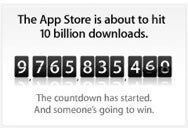
Download the App Store's 10 billionth app, win $10,000


Apple reached its 10 billionth song download on the iTunes Store last February after the music store had been open for seven years. By comparison, the App Store was only launched a little more than two years ago, and it’s already on the brink of achieving the milestone.So it is with the App Store, which is fast approaching its 10 billionth download, according to Apple’s figures. The company is counting down to the big number and giving away a $10,000 iTunes Gift Card to the lucky customer who nudges the App Store’s download count into 11-figure territory. We haven’t done any formal calculations, but we reckon that’s enough money to never have to pay for anything from the iTunes Store ever again. Or enough for 10 copies of I Am Rich, if that app ever makes it back to the App Store.

If you’d rather not take your chances by randomly downloading apps, you can still participate in the giveaway by filling out this form. If you happen to submit the form at the exact moment after the penultimate download, you will win the grand prize. You can enter up to 25 times a day, but at the rate that countdown is racing downwards you're far less likely to win than if you had entered the Frito-Lay Sweepstakes a million times.

Facebook backs off third-party data-sharing plan

by Ian Paul, PC World Jan 18, 2011 2:45 pm

Facebook has reversed its decision to let developers access your home address and mobile phone number through third-party applications and Websites. The decision came days after Facebook announced the new policy on its developer blog late Friday.

“Over the weekend, we got some useful feedback that we could make people more clearly aware of when they are granting access to [their home address and mobile phone number],” Facebook said in a blog post announcing the reversal. “We agree, and we are making changes to help ensure you only share this information when you intend to do so. … We look forward to re-enabling this improved feature in the next few weeks.”

The original plan

Facebook’s original intention was to let third-party developers request your home address and phone number through the pop-up windows you see the first time you use a Facebook game or log in to a Website using your Facebook ID. The new feature would not have allowed you to indirectly share your friends’ home addresses or mobile phone numbers. Facebook believed the new policy would make it easier for you to fill out membership forms on a Website with just one click or to sign up for mobile alerts for shopping deals in your area.

The problem is that it’s far too easy to miss the fact that an application or Website is asking for some fairly critical information linked to your identity. There are also security implications to consider, as security firm Sophos pointed out on its blogon Saturday. “Shady app developers will find it easier than ever before to gather even more personal information from users,” Sophos said. Malicious software on Facebook could be used to harvest phone numbers for SMS spam messages, knowing your home address could make it easier to steal your identity or your information could simply be sold to unscrupulous marketing firms, according to Sophos.

Given these potential security issues, Facebook says it is pulling the new feature until it can figure out how to properly notify you that an application wants to see your home address and phone number.

Facebook would only have access to your home address and mobile phone number if you’ve entered it into your profile. To see if you’ve done this, log in to Facebook and visit your profile page, click on the “Info” link in the left column and scroll down to the bottom where it says “Contact Information.” If you would like to edit your Facebook profile’s contact information click on the “Edit” link to the right of “Contact Information.”

What Facebook should do

Facebook argues that you only share your Facebook profile information with third parties when you explicitly choose to do so. But this position is somewhat disingenuous. Facebook has a habit of opening up more and more user data to third parties despite the fact that users expected this data to remain private. That was one of the reasons why 14 consumer protection groups led by the Electronic Privacy Information Center filed a complaint against Facebook with the Federal Trade Commission in 2010.

Secondly, the fact is developers get to decide which types of information they want to demand from Facebook users. If you disagree with an application’s desire to see your political views, for example, you have two choices: don’t use the application or hand over your information anyway so you can use the service.

That’s not much of a choice. If Facebook really wants to empower you to have control over your data, then it should give you the option to refuse to hand over your data and still be able to use the third-party app or service. True, there may be instances where an application must have a piece of information to work properly. After all, a birthday calendar on Facebook wouldn’t be of much use if it couldn’t access your birthday and your friends’ birthdays. But this is a minor problem that could be solved if Facebook required third-party developers to explain exactly why they want each piece of your profile data they are requesting.

Facebook should also consider an approval program for developers seeking to gain access to your home address and phone number. A formal review process would go a long way to allaying concerns about personal data being used irresponsibly or even criminally.

Facebook should be applauded for reversing its decision on allowing third-party developers to access your home address and phone number. But we’ll have to see what the world’s largest social network comes up with when it reintroduces this feature.

Loss of Reflectivity in the Arctic Doubles Estimate of Climate Models

ScienceDaily (Jan. 18, 2011) — A new analysis of the Northern Hemisphere's "albedo feedback" over a 30-year period concludes that the region's loss of reflectivity due to snow and sea ice decline is more than double what state-of-the-art climate models estimate.

The findings are important, researchers say, because they suggest that Arctic warming amplified by the loss of reflectivity could be even more significant than previously thought.

The study was published online this week in Nature Geoscience. It was funded primarily by the National Science Foundation, with data also culled from projects funded by NASA, the Department of Energy and others.

"The cryosphere isn't cooling the Earth as much as it did 30 years ago, and climate model simulations do not reproduce this recent effect," said Karen Shell, an Oregon State University atmospheric scientist and one of the authors of the study. "Though we don't necessarily attribute this to global warming, it is interesting to note that none of the climate models used for the 2007 International Panel on Climate Change report showed a decrease of this magnitude."

The cryosphere is the collective portion of the Earth's surface where water is in solid form and includes sea ice, snow, lake and river ice, glaciers, ice sheets and frozen ground. Most of these frozen areas are highly reflective, and "bounce" sunlight back into the atmosphere, keeping the Earth cooler than it would be without the cryosphere.

But as temperatures warm, ice and snow melts and reflectivity decreases, noted Shell, an assistant professor in OSU's College of Oceanic and Atmospheric Sciences.

"Instead of being reflected back into the atmosphere, the energy of the sun is absorbed by the Earth, which amplifies the warming," Shell said. "Scientists have known for some time that there is this amplification effect, but almost all of the climate models we examined underestimated the impact -- and they contained a pretty broad range of scenarios."

As part of the study, Shell, lead author Mark Flanner of the University of Michigan, and their colleagues compared Northern Hemisphere cryosphere changes between 1979 and 2008 in 18 different climate models to changes in actual snow, ice and reflectivity measurements of the same period. They determined that mean radiative forcing -- or the amount of energy reflected into the atmosphere -- ranged from 4.6 to 2.2 watts per meter squared.

During the 30-year study period, cryosphere cooling declined by 0.45 watts per meter squared. The authors attribute that decline equally to loss of snow and sea ice.

"Some of the decline may be natural climate variability," Shell said. "Thirty years isn't a long enough time period to attribute this entirely to 'forcing,' or anthropogenic influence. But the loss of cooling is significant. The rate of energy being absorbed by the Earth through cryosphere decline -- instead of being reflected back to the atmosphere -- is almost 30 percent of the rate of extra energy absorption due to carbon dioxide increase between pre-industrial values and today."

The "albedo" or reflectivity process is simple, scientists say, but difficult to measure on a broad scale. The reflectivity of ice and snow is obviously much greater than that of darker, unfrozen ground, or open sea water. But researchers also have discovered that variations in the snow and ice result in different albedo impacts.

For example, pools of melted water on top of sea ice can have significantly less reflectivity, which in essence may speed up the warming and possibly melting of that sea ice.

"While the current group of models underestimates these Northern Hemisphere cryosphere changes, new models will be released this year that will have better representations of snow and ice," Shell said. "This study will help climate modelers improve the new generation of models to better predict the rate of cryosphere and albedo decline in the future."

Eighth grader's iPhone game knocks Angry Birds from perch

Posted on Jan 18, 2011 2:05 pm by Matt Peckham, PC World

An iPhone physics-based puzzle game designed by a 14-year-old teenager has officially bumped another iOS physics-based puzzle game created by a team of 17 developers from its number one perch.

Haven’t heard of Bubble Ball? You will. It’s the new “Top Free” app in the iOS App Store, besting Chillingo's popular Angry Birds. It’s about moving a small blue ball from one side of the screen to the other by navigating shrewdly crafted obstacle fields built of metal or wood.

And it was built by eighth-grader Robert Nay of Spanish Fork, Utah, using Ansca Mobile’s Corona SDK (software developer’s kit). No wonder Ansca’s crowing about the story on its Website.

In fact, Bubble Ball was just released on December 29, and it’s already been downloaded more than 2 million times. Or 1 million. Reports conflict on the exact number. Either way, it’s a big one, and more than enough to put the game over Angry Birds.

It sounds like Nay tried Objective-C first, decided it was overly complex and moved over to GameSalad, before settling on the Corona SDK, which let him publish the game simultaneously for iPhone and Android.

ABC’s streaming the minute-40-second Good Morning America video segment here.

Note to ABC News: 14 years old is teenager turf, not tween

Microsoft breaks symbolic wall, brings OneNote to iPhone

Microsoft intros OneNote Mobile for iPhone


Microsoft put out its first full productivity app for the iPhone on Tuesday with the launch of OneNote for iOS (free, App Store). The previously Office-only notebook organizer app comes with many and in some cases more features than the Windows Phone 7 version. The iPhone app can not only produce notes but attach links and photos. Checklists and To Do lists are automatically formatted to let users mark items done on the spot.

Like other versions, it will sync with a free SkyDrive web account to keep updates current. Notes created in OneNote on another platform, including on the web, will open properly on the iPhone and can sync back without losing their formatting. Custom section colors do require making changes in the Windows app.

The app is currently available only in the US but is available for free for a "limited time." Microsoft didn't discuss international releases or how much it would cost as a paid app. Versions for the iPad, Android or other platforms are still unknowns.

Microsoft has already released apps for the iPhone before, including its Bing search and Tag Reader apps, but until now it has never offered an app that wasn't already intended to be cross-platform. It has usually tried to reserve Office apps for its own platform as selling points, such as on Windows Phone 7. An iOS app is a partial admission that competitors such as DataViz's Documents To Go have rendered the advantage obsolete and that official ports could encourage the use of Office on the desktop or in the cloud.


Would It Count As a Home Invasion or Grand Theft Auto?

white trash repairs - Would It Count As a Home Invasion or Grand Theft Auto?
If the truck’s a rockin’….report it to the authorities, that seems unsafe. This is the best example of a "pickle wagon" I've ever seen!